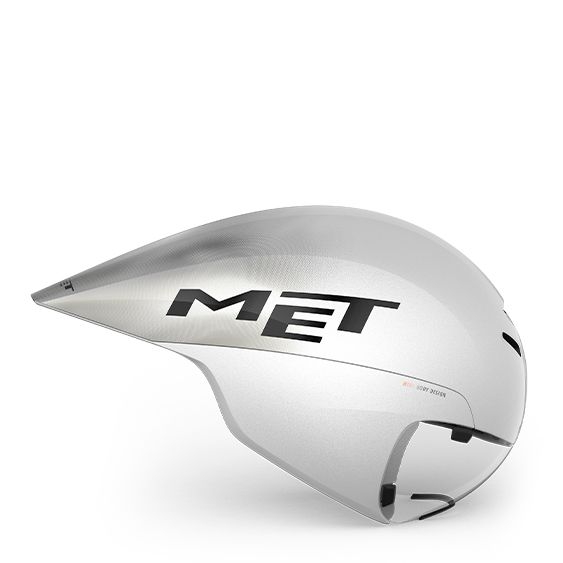
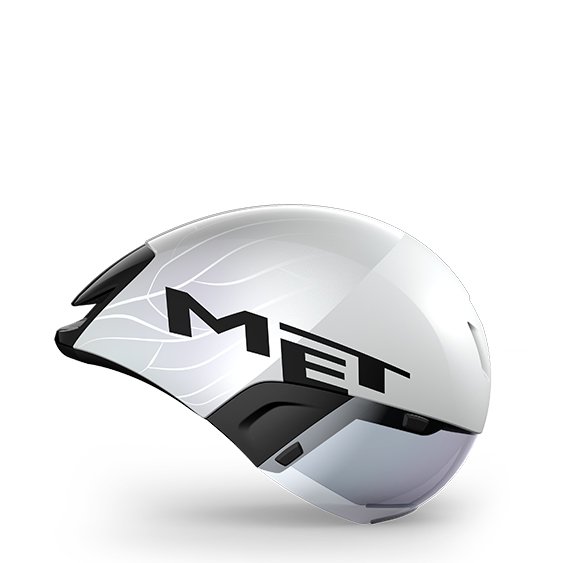
Entering into serious NDA territory.
Aero Project: Elisa Longo Borghini
The 34-year-old Elisa Longo Borghini from UAE Team ADQ hasn’t visited MET before. She walks into our warehouse that is home to the Tube and stops short. It isn’t the high-tech machinery of our wind tunnel that distracts her first – it’s the dog. Then a second one appears. On some days there can be up to six of them drifting through the building like they’re on payroll.
What to know?
_Location: MET’s HQ sits against the Orobic Alps, a slab of concrete towered over by the rocky mountains, with said wind tunnel taking up most of the ground floor, and big windows from the offices above it looking out over our favourite riding spots.
_TUBE: The Tube is our latest purpose-built space where helmets are tested and refined, giving us quite literally tunnel vision to improve aerodynamics and heat management.
_History: Before that, this building was our main factory – for years, every MET helmet passed through these walls. That history hasn’t quite left; everything still points towards this being a place built for making things.
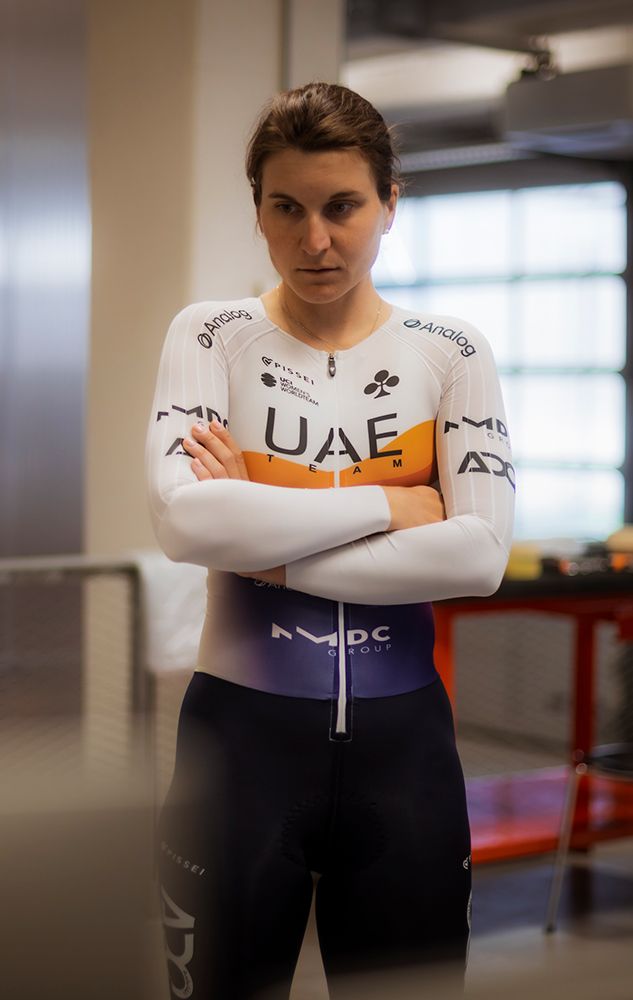
Today, we’re making our next aero helmet better with the help of UAE Team ADQ’s Elisa Longo Borghini, who is, objectively, a big deal. One of the most successful riders of her generation, she’s won the sorts of races people describe as “career-defining.” Yet here she’s low-key and modest. She shakes hands, looks around, and gets straight to work – the opposite of a diva, even when the engineers fuss with lasers and angles around her.
The rhythm of the day is repetitive on paper, but not in practice: on and off the bike as she tests a number of helmet prototypes in the wind tunnel at different yaw angles. Each run she tucks into the same position, holding it even when the watts wobble and the legs complain.
As she warms into the day, the conversation loosens in each break. She talks about her first season with her new team (“Really, really good. Even better than I expected.”). She talks about her time-trial photos, which she can’t stand looking at. “The harder I go, the more ragged my position,” she says, making a face. We tell her that’s normal. She gives us a look that suggests she thinks we’re being kind, not honest.
Meanwhile, the wind tunnel does what wind tunnels do. There’s a stream of digits on screens, two engineers nodding, a dog desperate to curl up with Elisa. She nudges it gently when she has to get back on the bike. “That’s a mood,” she says.
Prototypes, prototypes
The numbers of the various prototypes point toward something faster. Baseline data comes from the current helmet, the one that Elisa has raced in for the 2025 season. As she discusses her feelings on it, she holds it with a sense of connection. Then it was the turn of various prototypes, and we entered into full-blown NDA territory, testing advanced levels of speed and designs with fractions of millimetres in design differences.
By late afternoon, the sunlight has dropped behind the mountain, leaving the building in shade and the Tube falls quiet. She packs up, thanks everyone by name, and heads out with the dog trotting behind her until the door closes.
FInal word
Over the course of the day, 30 runs were measured. The data confirmed which prototypes are faster, but speed alone isn’t enough. Every rider is different, so the next step is refining the ways in which this aero helmet performs across all body shapes — maintaining aerodynamic efficiency even as fatigue sets in. The ultimate goal isn’t just fast numbers in a wind tunnel, but real-world performance for every rider, not only those with WorldTour-level flexibility or strength.